Agfa HealthCare vs Medicai for Enterprise Imaging Solutions
Hospital IT teams weighing Agfa HealthCare against Medicai face a concrete choice: on-premise hardware stacks or a cloud imaging service that scales without new servers. The decision now affects both annual operating costs and how quickly new imaging locations can go live. That choice also shapes which vendor will handle the next DICOM viewer update and the next compliance audit.
By the end of this article you will see the exact feature differences in cloud scalability, security controls, and third-party integrations; you will know the pricing models each platform publishes; and you will have a direct recommendation on which solution fits your current hospital network and future growth plans.
Quick Verdict: Agfa HealthCare vs Medicai for Enterprise Imaging Solutions
Medicai provides a cloud-native, zero-footprint DICOM platform while Agfa offers an established on-premise enterprise suite, making the choice hinge on deployment preference and scalability needs. Organizations gain immediate access to cloud imaging capabilities with Medicai, while Agfa requires significant infrastructure investment for local deployment.
Deployment models differ substantially between the two solutions. Agfa HealthCare follows traditional on-premise setups that demand dedicated servers, maintenance teams, and regular hardware upgrades. Medicai operates entirely through Microsoft Azure infrastructure, eliminating local hardware requirements and enabling rapid multi-site deployment across different geographic locations.
Core capabilities reflect these architectural choices. Agfa HealthCare delivers proven PACS and VNA functionality within established hospital environments. Medicai processes 1M+ studies per year and maintains 1.7M+ studies in storage while supporting 50M+ yearly API transactions through its cloud infrastructure.
Security and compliance standards meet enterprise requirements for both platforms. Medicai maintains HIPAA and GDPR compliance while following OWASP security guidelines. The platform also holds FDA and CEE clearance for its viewers, ensuring regulatory approval for clinical use.
Organizations that prioritize cloud access and zero-footprint viewing should select Medicai. This approach eliminates infrastructure costs, enables immediate scaling across multiple facilities, and provides mobile access without additional software installation requirements.
At a glance: how Medicai compares to Agfa HealthCare, Medicai for Enterprise Imaging Solutions on the features that matter most.
| Feature | Medicai | Agfa HealthCare | Medicai for Enterprise Imaging Solutions |
|---|---|---|---|
| Enterprise Imaging Solutions | ✓ | ✓ | ✓ |
What Is Medicai?
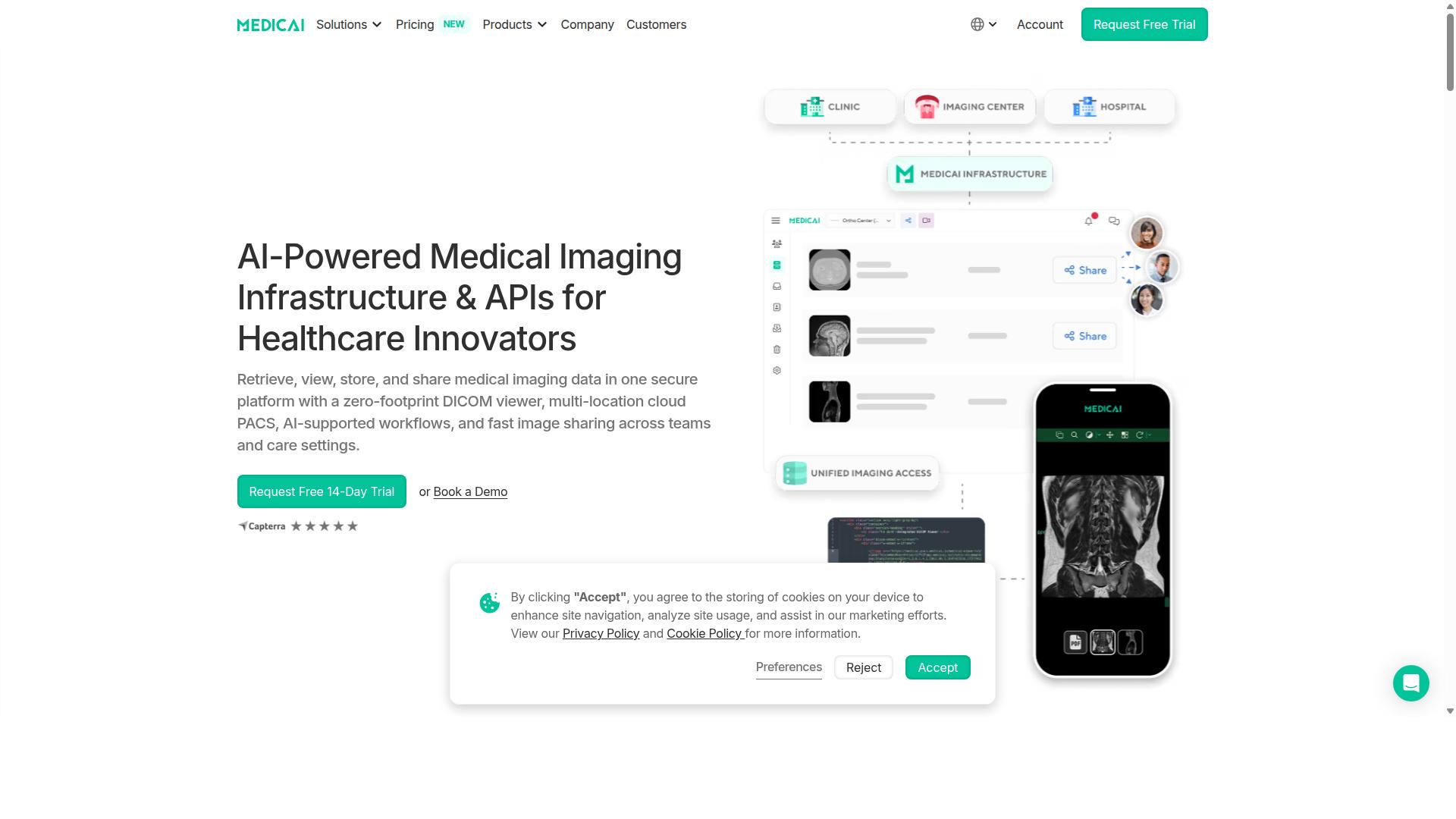
Medicai is a SaaS platform that lets providers retrieve, view, store, and share medical imaging data from any browser without installing software.
This cloud-based approach addresses key challenges in enterprise imaging. Traditional systems often require local installations and complex infrastructure. Medicai eliminates these barriers with its zero-footprint DICOM viewer that functions across different devices and locations.
The platform combines several core capabilities into one solution. Healthcare organizations can access a multi-location cloud PACS for centralized image management. They also gain AI-supported workflows that help streamline radiology processes.
Fast image sharing represents another key advantage. Teams across different care settings can exchange studies securely without physical media or complex transfer protocols. This capability supports both internal collaboration and external consultations.
Medicai provides Imaging Infrastructure as a Service (IIaaS) to modernize medical imaging workflows. The platform enables interoperability between different systems and departments. This approach helps healthcare providers manage their diagnostic imaging needs through a unified, accessible solution.
What Is Agfa HealthCare?
Agfa HealthCare provides a long-standing enterprise imaging portfolio that hospitals deploy on-premise or in hybrid configurations for radiology and cardiology workflows.
Traditional vendors like Agfa HealthCare focus on established PACS and VNA platforms that emphasize on-premise deployment models. These systems typically serve institutions with dedicated IT infrastructure and compliance requirements.
Enterprise imaging solutions from Agfa generally include diagnostic imaging capabilities, image archive functionality, and workflow management for medical imaging. The company positions itself as a provider of mature, locally hosted technology for healthcare organizations.
Organizations evaluating Agfa HealthCare often consider factors such as on-premise deployment needs, existing vendor relationships, and hospital-specific compliance standards. These considerations may vary based on institutional size and technical capabilities.
What Is Medicai for Enterprise Imaging Solutions?
Medicai serves enterprise imaging needs by combining a cloud PACS, Vendor Neutral Archive, and Medical Image Exchange into one HIPAA/GDPR-compliant solution.
The platform offers enterprise-grade capabilities through its Cloud PACS for storage and retrieval. It also includes a Vendor Neutral Archive that consolidates images from multiple modalities. Organizations gain access to Backup and Disaster Recovery services that protect critical medical data.
Image exchange functionality enables secure sharing across departments and facilities. The Medical Image Exchange component supports both internal collaboration and external referrals. This unified approach reduces the need for separate systems.
Additional offerings include structured reporting tools and AI-powered diagnostics. Teleradiology support extends access to specialists regardless of location. The platform maintains compliance with healthcare data protection standards throughout all operations.
Features Compared
Three critical dimensions separate the two platforms: cloud infrastructure, security posture, and integration depth.
Enterprise imaging decisions often hinge on these technical distinctions. Healthcare systems need reliable performance across multiple locations while maintaining strict data protections.
Each factor influences long-term operational costs and clinical workflows. The following sections examine how these platforms differ in practice.
Cloud Infrastructure and Scalability
Medicai's cloud architecture supports 50 million yearly API transactions and global multi-site deployments without additional hardware.
The platform operates entirely on Microsoft Azure infrastructure. This approach removes the need for hospitals to manage physical servers or local storage expansion projects.
Agfa HealthCare typically follows on-premise or hybrid deployment models. These setups require organizations to provision their own hardware and manage capacity planning internally.
Load balancing and high availability features come built into the cloud service. Multi-site deployments scale automatically as imaging volumes increase across different facilities.
Security and Compliance
Medicai is both HIPAA and GDPR compliant and cleared by FDA and CEE regulatory bodies.
The system follows OWASP security guidelines throughout its development process. Regular security audits help maintain protection standards for patient data across all stored studies.
Agfa HealthCare maintains enterprise-grade security with standard compliance certifications. Specific regulatory clearances vary depending on regional implementations and product versions.
Both platforms include audit logging and access controls. Healthcare organizations should verify current certification status for their specific deployment requirements.
Integration and Workflow
Medicai integrates via standard HL7 and FHIR protocols, enabling direct connectivity to RIS, EMR, and third-party AI tools.
The Medical Imaging Uploader and DICOM Gateway components facilitate data transfer from existing equipment. These tools connect with current radiology systems without requiring major workflow changes.
Agfa HealthCare provides traditional DICOM and HL7 support for imaging workflows. Integration capabilities depend on specific product configurations and may require additional middleware solutions.
API access allows third-party AI tools to connect directly with stored studies. This approach supports modern diagnostic workflows that incorporate machine learning assistance.
Pricing Compared
Medicai uses transparent monthly subscriptions while Agfa follows traditional capital-plus-maintenance licensing. Monthly pricing gives healthcare organizations clear visibility into ongoing costs without large upfront investments.
The Starter plan costs $249 per month and includes 500 GB of cloud storage plus unlimited user accounts, with no connected locations. This entry point works well for smaller radiology practices or individual specialists who need reliable enterprise imaging capabilities.
The Standard plan at $749 per month provides 2 TB of cloud storage with unlimited users and one connected location. Organizations can upgrade to yearly billing for 15 percent savings, bringing costs to $209 and $639 monthly respectively.
Agfa HealthCare pricing operates through custom enterprise contracts without published rates. These arrangements typically involve significant initial capital outlays combined with ongoing maintenance fees that can fluctuate based on negotiated terms.
Additional one-time fees apply for DICOM gateway setup at $1,000 per location when organizations need to connect external sites or imaging modalities. Enterprise customers may also explore per-study pricing options for specialized workflows.
Free 14-day trials of Starter plan features require no credit card, allowing teams to test core PACS and VNA functionality before committing. Refund policies do not apply to partial billing periods once subscriptions begin.
Who Should Choose Medicai
Organizations that need immediate global access, minimal IT overhead, and predictable monthly costs should evaluate Medicai first. Enterprise imaging platforms built on cloud infrastructure remove the need for on-site servers and extensive hardware maintenance. Hospitals gain reliable performance without managing physical infrastructure.
Imaging centers that handle high patient volumes benefit from scalable resources that adjust to demand. Medicai supports this through its SaaS model, eliminating hardware refresh cycles and reducing capital expenditures. Specialty providers gain similar advantages when they require consistent access to patient studies across multiple locations.
Teleradiology services often require rapid image exchange between remote radiologists and referring facilities. Medicai enables this workflow by providing web-based access without local installation. Virtual care providers and telemedicine platforms find the same accessibility useful when integrating diagnostic imaging into existing patient care pathways.
Medical education organizations and clinical trial coordinators need secure image sharing for collaboration. Medicai offers a Patient Portal that extends access to patients when required. Personal injury lawyers can review imaging records through the same system without additional software.
Specialty groups such as orthopedics, neurology, oncology, cardiology, and pulmonology frequently operate across different sites. Medicai accommodates these multi-site deployments while maintaining compliance with data security standards. This flexibility makes the platform suitable for providers who prioritize cloud imaging over traditional on-premise solutions.
Who Should Choose Agfa HealthCare
Health systems that already operate large on-premise data centers and require deeply customized workflows may lean toward Agfa. These institutions typically maintain dedicated IT teams and prefer direct control over hardware, security protocols, and system architecture. Such organizations value the ability to tailor enterprise imaging solutions to their specific operational needs.
Custom configuration becomes essential when radiology groups need to integrate legacy systems or maintain strict data residency requirements. Hospitals with existing infrastructure investments often find that keeping imaging data on-site aligns with their broader IT strategies. This approach suits facilities that handle sensitive diagnostic imaging without relying on external cloud providers.
Multi-site networks with established on-premise deployment models may also prefer this path. Organizations managing complex radiology workflow requirements across several locations sometimes need the granular control that traditional infrastructure provides. These health systems can maintain their preferred security frameworks and compliance standards through internal management.
Hybrid deployment options appeal to organizations transitioning gradually from fully on-site systems. Some facilities choose to keep certain image archives locally while exploring cloud capabilities for specific use cases. This middle-ground approach allows technical teams to test new workflows without committing to full infrastructure changes.
Enterprises prioritizing image lifecycle management within their own facilities often select this route. Health systems that process high volumes of medical imaging and need immediate access without internet dependencies may find local control more practical. Such organizations typically have the resources to maintain and upgrade their own PACS and VNA systems over time.
Who Should Choose Medicai for Enterprise Imaging Solutions
Multi-site hospital groups and diagnostic networks needing Vendor Neutral Archive, automated backups, and 24/7 image availability benefit most from Medicai. These organizations manage high imaging volumes across different locations and require reliable data storage that stays accessible at all times.
Medicai provides a cloud-based Vendor Neutral Archive that consolidates imaging data from multiple sources. The system stores DICOM studies without locking organizations into proprietary formats, which supports long-term data management across departments and facilities.
Backup and Disaster Recovery features protect imaging records against hardware failures and unexpected outages. Automated processes copy data to secure cloud locations, which helps maintain continuity when local systems experience problems.
Medical Image Exchange capabilities allow authorized users to share studies between sites without manual file transfers. This approach reduces delays when patients move between facilities or when specialists need remote access to images for consultation.
Diagnostic networks that operate across regions find these tools particularly useful. The combination of cloud storage, automated protection, and exchange functions addresses common challenges in coordinating care across separate locations.
Final Verdict
For providers prioritizing rapid deployment, global scalability, and transparent pricing, Medicai delivers measurable advantages.
Key differentiators emerge from verified performance metrics. Medicai processes 1 M+ studies per year across multiple healthcare systems while maintaining a total archive of 1.7 M studies. The platform supports 300 k visualizations annually, demonstrating capacity for high-volume enterprise imaging environments.
Agfa HealthCare solutions often require longer implementation cycles and infrastructure investments. Medicai offers cloud-native architecture that reduces hardware dependencies and shortens time to clinical value. This approach supports both multi-site deployment and hybrid deployment models without extensive on-premise modifications.
Interoperability remains essential for modern radiology workflow. Medicai supports DICOM, HL7, and FHIR standards for seamless integration with existing PACS, VNA, and EMR systems. The platform enables image exchange and teleradiology capabilities across organizational boundaries while maintaining compliance with HIPAA and GDPR requirements.
Providers evaluating enterprise imaging platforms should assess total cost of ownership, deployment speed, and global availability. Medicai combines these elements with proven scalability metrics that support growing healthcare networks.
Organizations ready to explore these capabilities can contact Medicai directly for detailed evaluations and implementation planning.
Medicai USA
7901 4th St N, STE 300
St. Petersburg, FL, 33702
Phone: +1 (832) 220 1035
Medicai Romania
53-55 N Filipescu, 5th Floor
Sector 2, Bucharest, 020961
Phone: +40 316 305 875
Email: sales@medicai.org